
A fire door tag is a permanent label that shows a door’s fire rating. It does not show that the door still works. That takes an annual inspection under NFPA 80. Many Florida property managers hear “fire door tagging” and assume one task covers both.
It does not. At CFBI Commercial Inspections, we inspect fire doors for commercial properties across Florida, and this mix-up comes up again and again.
This post covers what the tag means, what an inspector checks, and what to do when a door fails.
What Is Fire Door Tagging?
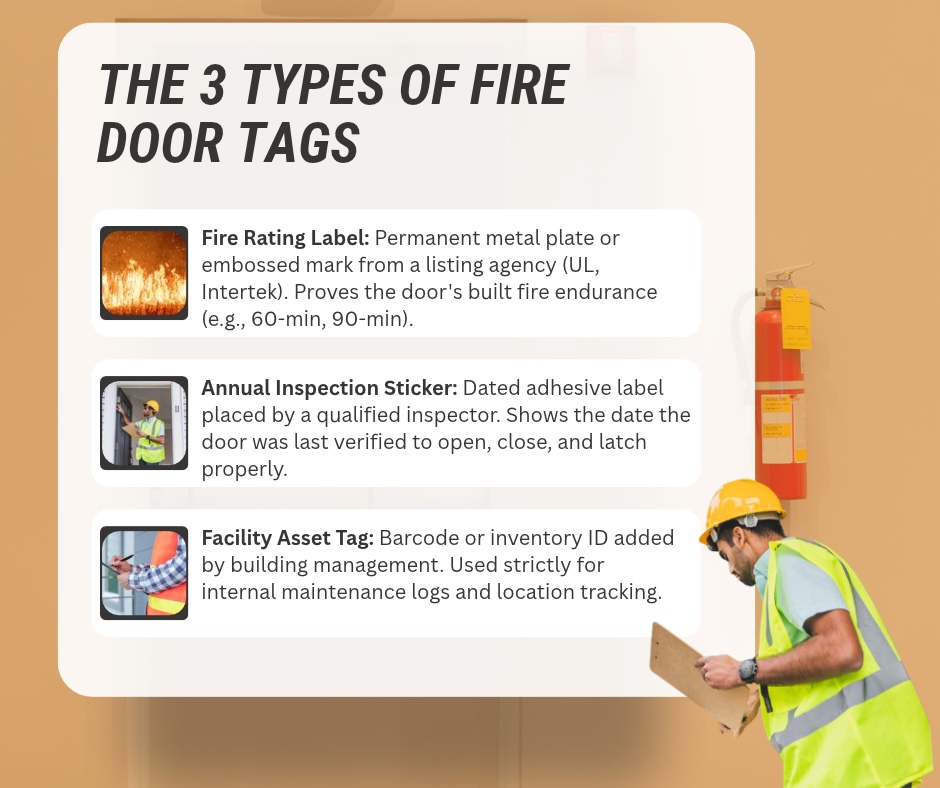
“Fire door tagging” is a loose term. It usually means the permanent label on a fire-rated door and its frame. People also use it for an inspection sticker, or for a number tag a building adds to keep track of each door. Here is how the three differ:
- Fire rating label: A permanent mark from a testing and listing agency such as UL, Intertek, or QAI. It sits on the edge of the door, usually on the hinge side, and shows the door’s rating. Georgetown University’s fire safety office shows what one looks like.
- Inspection tag or sticker: Some inspectors add a dated tag after an annual inspection. It records when the door was last checked.
- Asset tag: A barcode or number a building adds to track each door in a log.
Only the first one says anything about the door’s rating. The other two are record-keeping.
Is a Fire Door Tag the Same as a Fire Door Inspection?
No. A label shows what the door was built and tested to do. An inspection shows whether it can still do it today.
A door can carry a perfect label and still fail because it will not latch, has a gap that is too wide, or has a hole someone cut for a new lock.
| Label (the “tag”) | Annual inspection | |
|---|---|---|
| What it shows | The door’s fire rating | The door’s current condition |
| Who provides it | A testing and listing agency | A qualified inspector |
| How often | Once. It stays on the door. | At least once a year |
| Replaces the other? | No | No |
What Does NFPA 80 Require?
NFPA 80 is the standard for fire doors and other opening protectives. It calls for fire doors to be inspected and tested at least once a year, and for records of the results. The annual requirement has been in the standard since the 2007 edition.
The NFPA’s fire door FAQs are a good starting point for the basics.
In Florida, the State Fire Marshal points to NFPA 1 and NFPA 80 as the basis for annual fire door inspections. The state adopts those codes through Rule 69A-3.012.
A proposed amendment to that rule was published in June 2026, so the code edition in force may change. Ask your local fire marshal which edition applies to your building.
Enforcement varies by city, county, and building type. Health care buildings tend to see the most consistent enforcement. Lighter enforcement does not change the requirement.
What Does a Fire Door Inspector Check?
An NFPA 80 inspection looks at the whole door assembly, not just the label.
Our fire door certification inspections cover these items:
- Label: Present, readable, and not painted over.
- Door and frame: No holes, dents, cracks, or missing pieces.
- Gaps: The spaces around and under the door fall within the limits in the standard.
- Self-closing: The door closes on its own from any open position.
- Latching: The door latches fully every time.
- Hinges and hardware: Every piece is present, tight, and working.
- Seals and gaskets: Intact where the door requires them.
- Glass and vision panels: Intact and held in by the right frames.
- Obstructions: Nothing is wedged, blocked, or tied open.
Wedged-open doors are one of the easiest problems to spot on a walk-through. They are also one of the most serious, because a propped door cannot close when it is needed.

What happens after the inspection?
The inspector records each deficiency. NFPA 80 calls for repairs to be made without delay, and some local fire marshals set their own deadlines. A useful report lists each problem with photos and a repair recommendation.
Our digital reports include a compliance summary, so you can hand them to a fire marshal, an insurer, or an auditor.
What If a Door Has No Label?
A door with a missing, damaged, or painted-over label may not be treated as rated. The usual fixes are a field evaluation and labeling by a listing agency, or replacing the door.
A painted-over label is an easy mistake during building upkeep, so tell your painters and maintenance crew to leave labels alone. Check with your local fire marshal before you decide which route to take.
What Are the Most Common Fire Door Problems?
The most common problems are doors that will not close or latch, doors held open, and damage that has built up over time. Most of them come from daily use and building upkeep, not from the door itself.
Here are the ones we see most often, with the usual fix:
| Problem | What it looks like | Usual fix |
|---|---|---|
| Held open | A wedge, a chair, or a rope keeps the door open | Remove it. Ask the fire marshal about approved hold-open devices. |
| Will not latch | The door closes but does not catch | Adjust or replace the latch and strike plate |
| Slow or weak closer | The door drifts shut or stops short | Adjust or replace the closer |
| Gaps too wide | Daylight shows around or under the door | Adjust hinges, or replace worn parts |
| Unapproved holes | Cut-outs for a new lock, a sign, or a cable | A repair method that suits the door, or a replacement |
| Missing hardware | Loose or missing hinge screws or pins | Replace with matching hardware |
| Damaged seals | Gaskets are torn, painted over, or gone | Replace the seal |
Some of these are quick maintenance fixes. Others, such as holes in the door face, need a qualified person to decide on the repair. Do not patch a fire door with whatever is on hand.
How Do You Prepare for a Fire Door Inspection?
A little prep saves time on inspection day and makes the report more useful. Follow these steps:
- Make a door list. Number each fire door and note its location. A simple floor plan with marked doors works well.
- Clear the way. Move storage and equipment away from doors, and make sure the inspector can reach stairwells, mechanical rooms, and locked areas.
- Pull past reports. Share earlier inspection reports and repair records so the inspector can see what changed.
- Note known problems. Tell the inspector about doors that stick, slam, or do not latch.
- Have maintenance on call. Someone who knows the building can answer questions and make small fixes the same day.
Why Do Inspection Records Matter?
Records are the proof that the work happened. A fire marshal, an insurer, or an auditor may ask to see them, and “we checked it last spring” will not satisfy any of them.
Keep each dated report on file, along with notes on every repair. Store them by door number so you can show the full history of a single door in seconds.
The label stays on the door for its whole life. The inspection record is what shows how that door has been kept up year after year. Together, the two tell the full story.
Related Questions to Explore
How often do fire doors need to be inspected?
At least once a year under NFPA 80. Doors also need an inspection after installation.
Are fire door inspections a legal requirement?
In Florida, the State Fire Marshal’s rules adopt NFPA 80, and annual inspection is generally expected. Local enforcement varies, so confirm the details with your local fire marshal. See the section on NFPA 80 above for the code background.
Who can inspect fire doors?
NFPA 80 expects a knowledgeable, qualified person. Training programs for fire door inspectors exist, and local fire marshals may have their own expectations. Ask any inspector what training they hold and what experience they have with your building type. Our commercial inspection overview explains how our process works.
How much does a fire door inspection cost?
It depends on how many doors your building has, what types they are, and where the property sits. We cannot give a flat number here. Send us a door count, and we will quote it.
What is a fire-rated tag on a door?
It is the label from a listing agency that shows the door’s fire rating, in minutes or hours. It is not an inspection record. See the first section above for how it differs from an inspection tag.
When to Call a Professional
You can do a quick check yourself. Read the label on each door. Open each one and let it go, then watch it close and latch. Look for wedges, holes, and loose hardware. This catches obvious problems.
It does not replace a formal NFPA 80 inspection with a written report. Call a professional when:
- Your annual inspection is due or overdue.
- A fire marshal, insurer, or lender asks for inspection records.
- A door will not close or latch on its own.
- A door has no label, or the label is painted over.
- You have renovated or changed door hardware.
- You are buying or leasing a commercial property and want to know what you are taking on. Our commercial property inspectors can help with that too.
CFBI is a family-owned company based in Winter Garden, and we have served all of Florida since 1988.
Conclusion
- A tag shows a door’s rating. An inspection shows its condition.
- NFPA 80 calls for fire doors to be inspected at least once a year, and Florida’s State Fire Marshal points to it.
- Keep dated inspection reports on file so you can show them when asked.
If your doors are due, schedule an inspection or read more about our fire door certification inspections.