

A Phase 1 site assessment is a review of a commercial property’s past and present use. It looks for signs of contamination before you buy the property or lend on it. Nobody digs up soil or takes samples. An environmental professional studies records, walks the site, and interviews people who know the property.
At CFBI Commercial, we have protected Florida commercial properties since 1988. We often see deals slow down because a buyer ordered the report too late or didn’t know what the lender needed.
This guide covers what a Phase 1 includes, how long it takes, what drives the cost, what lenders look for, and the Florida issues that come up most often.
What Is a Phase 1 Site Assessment?
A Phase 1 site assessment, also called a Phase I Environmental Site Assessment (ESA), is a due diligence report. It checks whether hazardous substances or petroleum products may have affected a property.
The current standard for the work is ASTM E1527-21. A qualified environmental professional (EP) has to perform it.
The report’s main job is to find Recognized Environmental Conditions, or RECs. You will see these terms in almost every report:
| Term | What it means for you |
|---|---|
| REC (Recognized Environmental Condition) | Contamination is present or likely present because of a release. It can also mean conditions that pose a real threat of a future release. |
| CREC (Controlled REC) | A past release was addressed to the regulator’s satisfaction, but some contamination stays in place under controls such as a deed restriction. |
| HREC (Historical REC) | A past release was cleaned up to the point where the property can be used without restrictions. |
| De minimis condition | A minor issue, like a small stain, that would not likely lead to enforcement action. |
| Data gap | Missing information that limits what the EP can conclude. |
A Phase 1 does not “pass” or “fail.” It gives you the EP’s findings and opinions so you and your lender can decide what to do next.
It also doesn’t cover everything. Asbestos, lead-based paint, radon, mold, and wetlands are outside the standard scope unless you add them.
A Phase 1 also doesn’t look at the roof, HVAC, or structure. Those belong in a property condition assessment.
Why Do Buyers and Lenders Need a Phase 1?
Buyers need a Phase 1 to protect themselves from cleanup costs. Lenders need one to protect the property that backs their loan. Florida law doesn’t require one for a commercial sale, but most commercial lenders and many buyers won’t close without it.
How a Phase 1 Protects Buyers
Under the federal Superfund law (CERCLA), a current owner can be held liable for cleanup costs even if they didn’t cause the contamination.
To qualify for one of the law’s landowner defenses, you have to complete “All Appropriate Inquiries” (AAI) before you buy. The federal AAI rule in 40 CFR Part 312 spells out what that means, and a Phase 1 done to ASTM E1527-21 meets it.
AAI supports three defenses:
- Bona fide prospective purchaser: You can be protected even if you knew about contamination, as long as you did proper inquiry before buying.
- Innocent landowner: You did proper inquiry and had no reason to know about the contamination.
- Contiguous property owner: Contamination migrated onto your property from a neighboring site.
Keeping these defenses also means meeting ongoing duties after closing. For example, you have to take reasonable steps to stop or limit any continuing release.
How a Phase 1 Protects Lenders
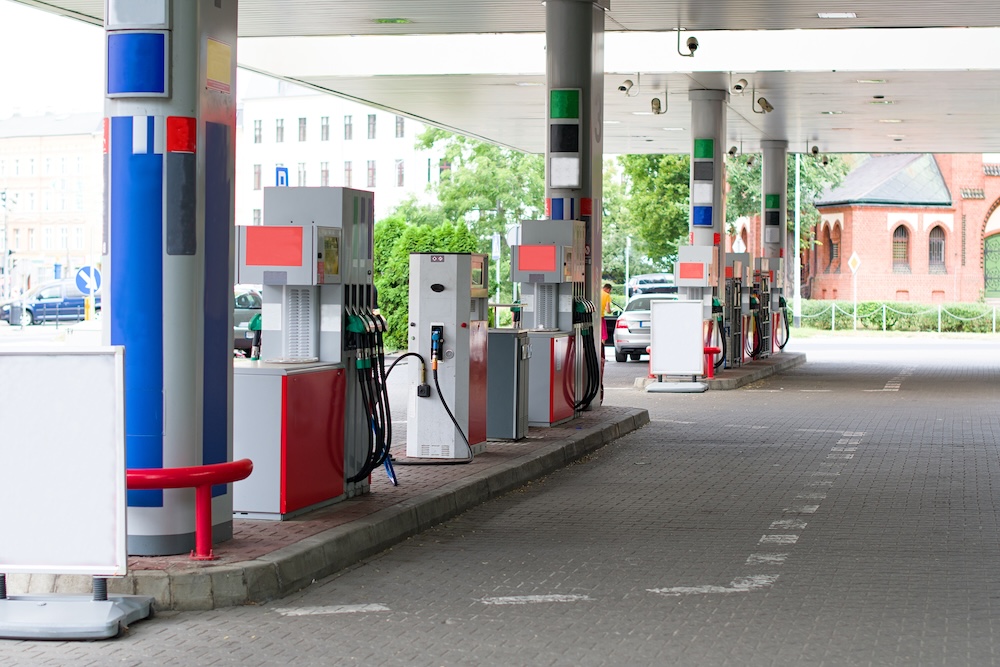
A contaminated property is worth less and harder to sell. If a lender forecloses, it doesn’t want to inherit a cleanup. That is why banks, credit unions, and SBA lenders build Phase 1 requirements into their loan terms.
SBA loans follow the agency’s SOP 50 10 environmental policy, and higher-risk property types such as gas stations and dry cleaners usually need a full Phase 1.
Your lender will tell you exactly which report it needs, how it wants the report addressed, and how recent it has to be.
What Happens During a Phase 1 Site Assessment?
A Phase 1 has four main parts: a records review, a site visit, interviews, and a written report. Here is what each step looks like.
1. Records Review
The EP searches federal, state, tribal, and local environmental databases. In Florida, that includes Florida Department of Environmental Protection (FDEP) records on cleanup sites and storage tanks.
The EP also traces the property’s history through sources like:
- Historical aerial photos
- Fire insurance maps
- City directories
- Topographic maps
- Building department and permit records
The goal is to learn how the property and nearby properties were used over time, going back to the first developed use.
2. Site Reconnaissance
The EP walks the property and looks at nearby sites. Common warning signs include:
- Stained soil or pavement
- Drums or chemical containers
- Vent pipes or fill ports that point to underground storage tanks (USTs)
- Floor drains, sumps, or pits
- Stressed vegetation or strange odors
3. Interviews
The EP talks with the current owner, occupants, and sometimes past owners or local officials. A tenant who has run a business there for 20 years often knows things no database shows.
4. The Written Report
The report lists findings, opinions, conclusions, data gaps, and the EP’s signed declaration. It also records key dates, which matter for how long the report stays valid.
What You Provide as the Buyer
ASTM E1527-21 gives the buyer (the “user”) duties too.
You’ll be asked about environmental liens, any land use limitations, anything you already know about the property, and whether the purchase price is lower than fair market value because of possible contamination.
Title records help here, so share them with your EP early.
How Long Does a Phase 1 Take, and How Long Is It Good For?
Most Phase 1 reports take a few weeks from order to final report. The biggest delays usually come from slow agency record requests, limited site access, or a property with a long industrial history.
Once it’s done, the clock starts. Under 40 CFR 312.20, AAI must be completed within one year before you acquire the property. Five parts have to be done or updated within 180 days before closing:
| Report component | Must be current within |
|---|---|
| Interviews with owners and occupants | 180 days |
| Search for environmental liens | 180 days |
| Review of government records | 180 days |
| Site visit | 180 days |
| EP’s signed declaration | 180 days |
| Overall inquiry | 1 year |
If your closing slips past the 180-day mark, you’ll need an update. Plan the order date around your contract timeline so you aren’t paying for a report twice.
How Much Does a Phase 1 Cost in Florida?
A Phase 1 usually costs a small fraction of what a cleanup could cost, and the price depends on the commercial property.
These factors move the price the most:
- Size and number of parcels. More ground to walk and more records to pull.
- Past use. A former gas station, dry cleaner, or auto shop takes more research than a newer office building.
- Number of buildings and tenants. Each tenant space may need a look.
- Record availability. Some Florida counties and older sites have spotty records.
- Rush timing. A short due diligence period can mean paying for faster turnaround.
- Lender requirements. Some lenders need specific formats or a reliance letter.
Florida Issues That Show Up in Phase 1 Reports
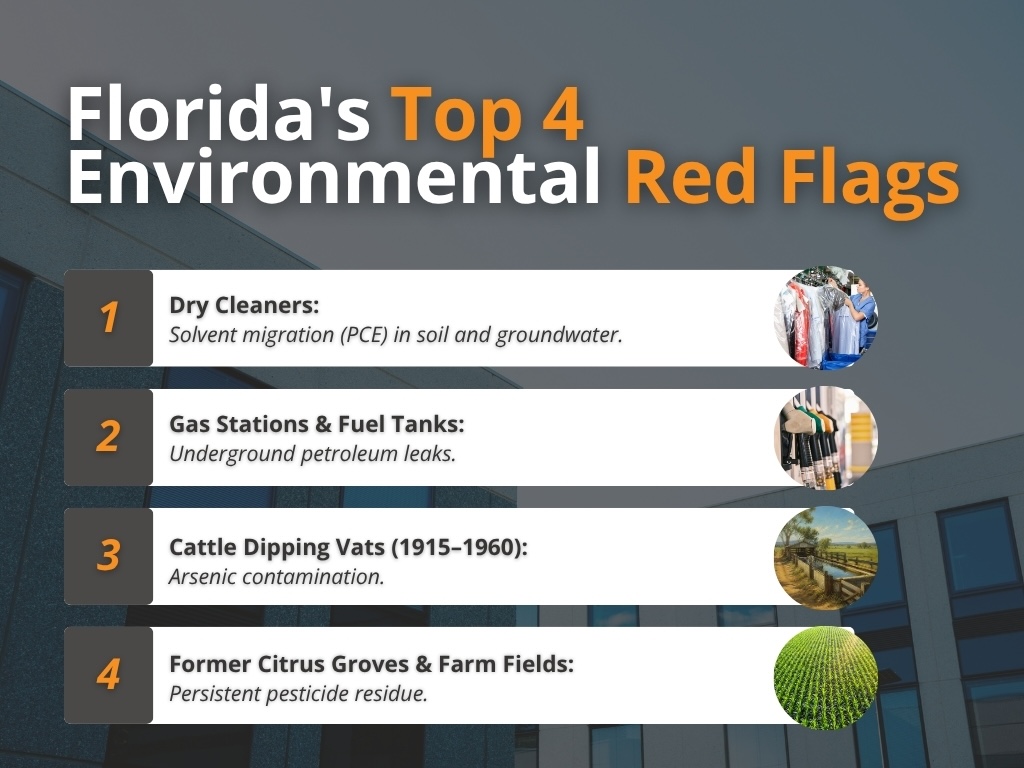
Florida’s history of dry cleaners, fuel stations, and cattle and citrus farming shapes what an EP looks for here. National checklists don’t always cover these local risks.
| Past use | Why it matters in Florida |
|---|---|
| Dry cleaners | Cleaning solvents such as perchloroethylene (PCE) can move through soil and groundwater. Florida runs a Drycleaning Solvent Cleanup Program that can offer eligible property owners state-funded cleanup and limited liability protection. |
| Gas stations and fuel tanks | Leaking petroleum storage tanks are among the most common findings. FDEP’s Petroleum Restoration Program tracks and funds cleanup at many of these sites. |
| Cattle dipping vats | More than 3,200 vats were used in Florida from about 1915 to 1960, mostly with arsenic. FDEP notes that no complete list of cattle dipping vat locations exists, so aerial photos and interviews matter. |
| Former groves and farm fields | Past agricultural use can leave pesticide residue, which is common as Central Florida land turns into retail and industrial sites. |
| Brownfield sites | Florida’s Brownfields Redevelopment Program offers incentives for cleaning up and reusing these properties. |
Neighboring properties matter too. A dry cleaner across the parking lot or a fuel station next door can show up as a concern for your parcel.
Phase 1 vs. Phase 2: What Happens If a REC Is Found?
If a Phase 1 finds a REC, the usual next step is a Phase 2 ESA. That’s where testing happens. A Phase 2 samples soil, groundwater, or soil vapor to confirm whether contamination is present and how bad it is.
| Phase 1 ESA | Phase 2 ESA | Property Condition Assessment | |
|---|---|---|---|
| Main question | Is contamination likely? | Is contamination present, and how much? | What shape is the building in? |
| Sampling? | No | Yes | No |
| Standard | ASTM E1527-21 | ASTM E1903 | ASTM E2018 |
| Typical trigger | Any commercial purchase or loan | A REC in Phase 1 | Purchase, refinance, or lease |
A REC doesn’t have to kill your deal. Common paths forward include:
- Order a Phase 2 to get real data
- Renegotiate the price or set up an escrow for cleanup
- Ask the seller to handle cleanup before closing
- Check whether a state cleanup program applies
- Walk away if the risk is too high
Expect your lender to pause the loan until the REC is resolved or explained.
Related Questions to Explore
Who pays for a Phase 1 environmental site assessment?
The buyer usually pays, because the buyer is the one who needs the liability protection. Sometimes a seller orders one to market a property, or the parties split the cost. When a lender orders the report, the borrower typically covers it at closing.
Why do I need a phase 1 environmental site assessment?
You need one to protect yourself from cleanup liability under federal law and to meet your lender’s loan conditions. It also gives you bargaining power if the report turns up a concern.
What is included in a Phase 1 environmental site assessment?
A records review, a site visit, interviews, and a written report signed by an environmental professional. See our Florida Phase 1 Environmental Assessment services for a full breakdown of what CFBI covers.
Do Phase 1 environmental site assessments expire?
Yes, in practice. For CERCLA protection, the inquiry must be done within one year before you buy. Key parts, including the site visit and records review, must be updated within 180 days of closing.
Can I use the seller’s old Phase 1 report?
Usually only if it’s recent enough and you get a reliance letter from the firm that wrote it. You’d still need updates for anything older than 180 days, and many lenders want a report prepared for them.
Is a Phase 1 the same as a commercial property inspection?
No. A Phase 1 looks for environmental contamination risk. A commercial inspection looks at the building’s systems and condition. Many buyers order both. Here’s what to expect from a Florida commercial inspection.
When to Call a Professional
Call as soon as you have a signed contract, or sooner if your due diligence window is short. Records requests and site access take time, and you don’t want the report arriving after your inspection period ends. Bring in a qualified EP right away if:
- Your lender or the SBA has asked for a Phase 1
- The property was ever a gas station, dry cleaner, auto shop, factory, or farm
- A high-risk business sits next door or across the street
- You’re buying a triple net property and taking on long-term responsibility for the site
- A seller’s report is more than 180 days old
CFBI Commercial works across Florida from offices in Orlando, Winter Garden, and Tampa. When you call, you talk to an experienced member of our office staff or a certified inspector, never an answering service. Many clients pair a Phase 1 with a property condition assessment or triple net lease inspection so they get the full picture in one due diligence period.
Conclusion
A Phase 1 site assessment is the first and cheapest step in protecting a Florida commercial purchase or loan.
- It reviews records, the site, and interviews to find RECs, without sampling.
- Key parts must be current within 180 days of closing, so time your order carefully.
- Florida risks like dry cleaners, fuel tanks, and old cattle dipping vats deserve a close look.
If you’re under contract or planning a loan, schedule your Florida Phase 1 Environmental Assessment with CFBI Commercial, or call 407-635-1020 to talk through your timeline.